
If you have noticed diagonal hairline cracks spreading above your doorframes, sticking windows, or a widening gap in your brick veneer, your home may be suffering from foundation settlement. In Murfreesboro, Tennessee, structural settlement is an all-too-common threat due to the region's volatile geological profile.
When a home's footings sink, cosmetic patches or basic concrete repairs will not stop the structural movement. The only permanent method to stabilize and potentially lift a settling structure back toward its original position is foundation underpinning through steel piering. However, homeowners facing foundation repairs generally must choose between two primary engineering solutions: push piers and helical piers. Understanding how these two pier systems perform in Rutherford County soil—and what they cost—is essential before making a capital investment in your home.
Understanding Foundation Settlement in Murfreesboro, TN
To choose the right underpinning solution, you first need to understand why foundations fail in Middle Tennessee. The soil composition throughout Murfreesboro and the surrounding Rutherford County areas creates severe environmental pressures on residential footings.
How Expansive Limestone & Clay Subsoil Damage Footings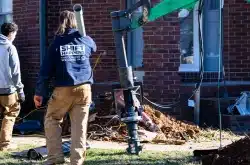
Murfreesboro sits on a bedrock foundation dominated by Ordovician limestone topped with thick layers of highly expansive red clay soil. This clay acts like a giant sponge—expanding significantly during heavy spring rains and contracting during dry summer spells. This continuous expand-contract process, known as thermal and moisture cycling, strips away support under your concrete slab or stem-wall footings. Over time, the soil becomes too weak to hold the weight of the structure, causing uneven settlement.
Key Structural Indicators of Settlement
- Interior Drywall Cracks: Stair-step or diagonal shear cracks running from the corners of door and window frames.
- Exterior Masonry Cracks: Fractures running through brick mortar or splitting exterior brick veneer.
- Sticking Openings: Interior doors sticking, binding in their frames, or failing to latch shut.
- Uneven or Sloping Floors: Gaps forming between baseboards and the subfloor, or noticeable floor sloping.
Push Piers vs. Helical Piers: Structural & Engineering Comparison
Both push piers and helical piers are engineered steel shafts installed beneath a foundation to bypass unstable upper soils, driving down to deep load-bearing strata or solid limestone bedrock. However, their installation mechanics and structural applications differ significantly.
Steel Push Piers (Resistance Piers)
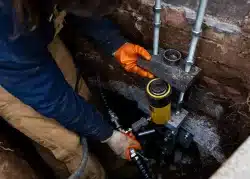
Push piers consist of heavy-duty, hollow steel pipe sections driven deep into the earth using hydraulic rams attached directly to your home’s concrete footing via heavy steel brackets.
- Installation Mechanism: Push piers utilize the structural weight of the building itself as resistance to drive the steel sections straight down into the soil until solid bedrock or dense load-bearing strata is reached.
- Ideal Application: Best suited for heavy residential structures, such as multi-story homes, full brick-veneer residences, or heavy concrete slab foundations.
- Depth Capabilities: Because push piers are driven until absolute refusal (striking bedrock), they often reach depths between 20 to 40+ feet in Middle Tennessee.
Helical Piers (Helical Piles)
Helical piers feature round steel shafts outfitted with one or more curved, screw-like plates (helices) welded near the bottom tip.
- Installation Mechanism: Instead of relying on structural weight, helical piers are turned into the earth using a hydraulic torque motor—screwing into the ground much like a wood screw penetrates timber.
- Ideal Application: Excellent for lighter residential structures (wood-sided homes, single-story crawl space homes, porches, decks) or new construction applications where the structure's weight is insufficient to drive push piers.
- Engineering Verification: Torque resistance is recorded in real time during installation to mathematically verify exact load capacity before load transfer.
Cost & Performance Breakdown in Middle Tennessee
Investing in foundation piering provides a permanent engineering fix, but costs vary depending on structural demands, depth to bedrock, and accessibility around the home perimeter.
| Factor | Steel Push Piers | Helical Piers |
|---|---|---|
| Average Cost Per Pier | $1,800 – $2,600 | $2,100 – $3,000 |
| Installation Load Dependency | Requires heavy building weight to push piers down | Independent; relies on torque measurement |
| Depth to Load Strata | Driven to absolute bedrock refusal | Driven to specific engineered torque depths |
| Vibration & Disturbance | Low excavation, high vertical force | Minimal excavation, smooth rotational torque |
| Lift Capabilities | High hydraulic lifting capacity | Excellent stabilization & controlled lifting |
While push piers are slightly lower in per-unit material cost, total project investment depends on how many piers are needed to support the affected load-bearing walls. A typical residential settlement repair in Murfreesboro requires anywhere from 5 to 12 piers, placing average structural stabilization projects between $10,000 and $28,000+.
Frequently Asked Questions (FAQ)
1. How do I know whether my home needs push piers or helical piers?
A structural inspection determines the right system based on your home's weight, framing style, and site-specific soil depths. Two-story brick homes on heavy footings almost always benefit from steel push piers driven to bedrock. Lighter wood-frame homes, room additions, or homes built over deep pockets of soft clay often perform better with helical piers.
2. Can foundation piering lift my house back to its original level position?
Yes. Once piers reach load-bearing strata or bedrock, high-capacity hydraulic jacks are connected to the footing brackets. In many cases, contractors can lift the settled portion of the house back toward its original position, closing drywall cracks, restoring door alignment, and narrowing exterior masonry gaps.
3. Is foundation piering covered by homeowners insurance in Tennessee?
Standard homeowners insurance policies generally exclude gradual foundation settlement caused by natural clay expansion or soil shifting. However, addressing foundation settlement promptly stops compounding structural damage and preserves your home's total resale value and structural integrity.
Protect Your Home's Structural Integrity Today
Foundation settlement never fixes itself—ignoring early warning signs only increases the number of piers required to stabilize your home over time. Protect your equity, safety, and property value with an engineered underpinning solution.
Don't let settlement compromise your property. Contact Foundation Solutions Group today at (615) 813-5687 or request a Free On-Site Foundation Repair Inspection in Murfreesboro, TN to secure your home with lifetime-warranted steel piering systems.