
Fixing Sagging Floors Over Crawl Spaces in Franklin & Middle, TN
Ignoring uneven floors won't just ruin your home’s interior aesthetics; left unaddressed, substructure decay will lead to cracked drywall, failing tile, jammed doors, and severe structural damage. In this guide, we break down why floors sag in Middle Tennessee homes and how engineered floor stabilization systems can permanently restore your home’s structural integrity.
The 3 Main Causes of Sagging Floors in Middle Tennessee
Middle Tennessee's climate, paired with local construction styles, creates a unique set of challenges for crawl space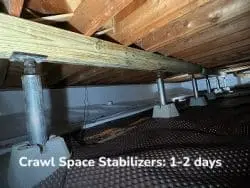
1. High Crawl Space Humidity & Wood Rot
Middle Tennessee summers bring intense heat and relative humidity levels that frequently exceed 70–80%. In traditional vented crawl spaces, humid outside air enters through open vents and meets cooler temperatures beneath the home. Moisture condenses directly onto wooden floor joists, subfloor panels, and support beams.
Over time, wood moisture content rises above 20%, inviting wood-decay fungi (rot) and mold. As the wood fiber decomposes, it loses its load-bearing strength, causing joists to bow and sag under the weight of your home.
2. Overspanned or Undersized Floor Beams
Many historic homes in Franklin, as well as suburban developments built prior to modern building code updates, suffer from inadequate framing support. Girders and floor joists that were spaced too far apart (overspanned) or constructed from undersized lumber will naturally sag over time simply under the weight of heavy furniture, appliances, and daily foot traffic.
3. Soil Settlement Under Support Piers
Traditional crawl space construction relies on masonry or concrete block piers resting on shallow dirt footings. Middle Tennessee features clay-heavy soils that expand when wet and shrink when dry. As wet soil softens or dry soil shrinks, these shallow support piers sink or shift, causing the floor grid above them to drop.
How Heavy-Duty Adjustable Steel Jacks Restore Your Floors
Fixing uneven or bouncy floors requires more than slapping a temporary wooden wedge or a cheap post under a beam. Permanent restoration requires a heavy-duty, engineered support system capable of lifting and stabilizing heavy floor loads.
At Foundation Solutions Group, we utilize high-capacity, adjustable steel crawl space jacks designed specifically to solve substructure settlement:
- Solid Footing Installation: We excavate soft topsoil and pour heavy-duty concrete footings beneath each support point to ensure the weight is distributed onto stable, dense soil.
- Galvanized High-Strength Steel Jacks: Heavy-gauge, corrosion-resistant steel columns are custom-fitted beneath your existing floor beams. Each jack post is capable of supporting tens of thousands of pounds.
- Precision Lifting: Using hydraulic equipment, our technicians slowly and systematically adjust the threaded steel jacks to lift floor joists back toward their original level position, closing floor gaps and restoring stability.
- Joist & Beam Reinforcement: If high humidity has rotted existing wood framing, damaged joists are reinforced ("sistering") with new pressure-treated lumber alongside the steel jack system.
Why Floor Stabilization Must Be Paired with Moisture Control
Installing steel floor jacks solves the structural support issue, but if your crawl space remains damp and humid, wood decay will continue to spread to adjacent framing, and metallic components will suffer premature corrosion.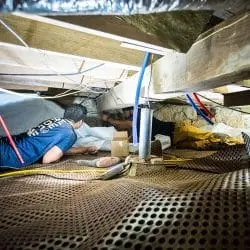
To ensure your floor repair lasts a lifetime, structural lifting should be paired with complete crawl space encapsulation. Sealing foundation vents, installing a heavy-duty reinforced vapor barrier, and mounting a commercial-grade dehumidifier lock out moisture, stop rot, and protect your newly leveled floors permanently.
Frequently Asked Questions About Sagging Floor Repair
How much can adjustable crawl space jacks lift my floors?
Adjustable steel floor jacks are engineered to lift thousands of pounds per post. In most cases, floors can be lifted back very close to their original level position. Our technicians lift the structure slowly and carefully to minimize stress on interior finishes like drywall and tile.
Will lifting my sagging floor crack my interior drywall or tile?
Because foundation floor jacks are adjusted incrementally over controlled intervals, interior stress is minimized. Minor cosmetic hairline cracks in older plaster or drywall mortar may occasionally occur during a lift, but this is a standard byproduct of returning a shifted home frame to its proper alignment.
How long does it take to install crawl space floor jacks?
Most residential crawl space floor stabilization projects in Franklin and Middle Tennessee are completed within 1 to 2 days, providing immediate structural stabilization to your living space without requiring you to move out of your home.
Restore Safe, Level Floors to Your Middle Tennessee Home
Don't wait for rotting joists or sinking piers to cause further damage to your property. Contact Foundation Solutions Group today to schedule a free, comprehensive crawl space and floor inspection in Franklin, TN, and surrounding areas.